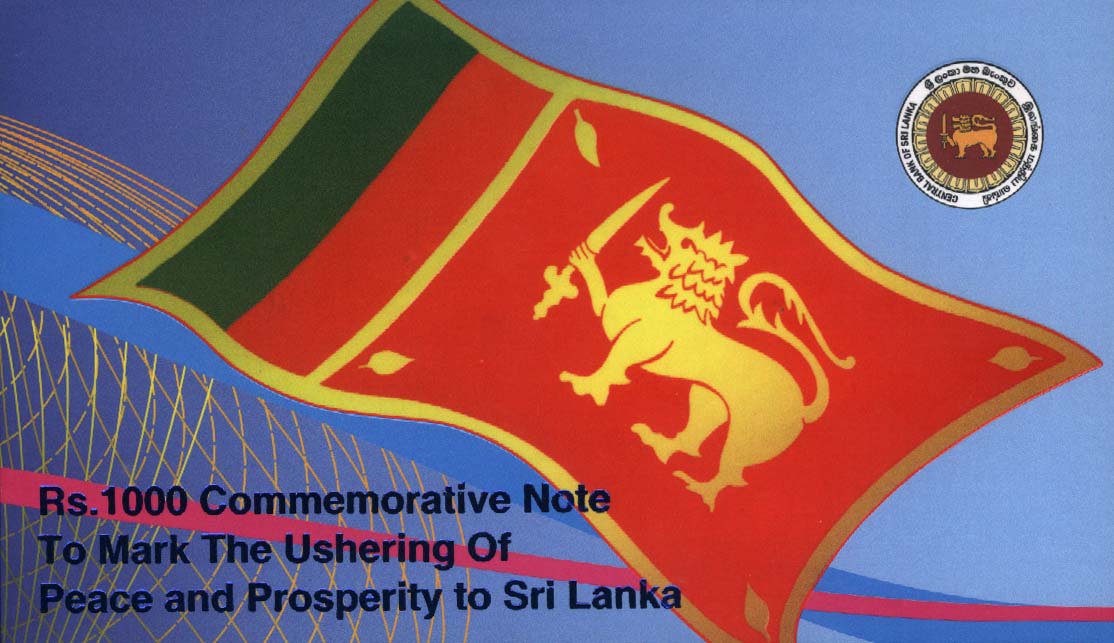
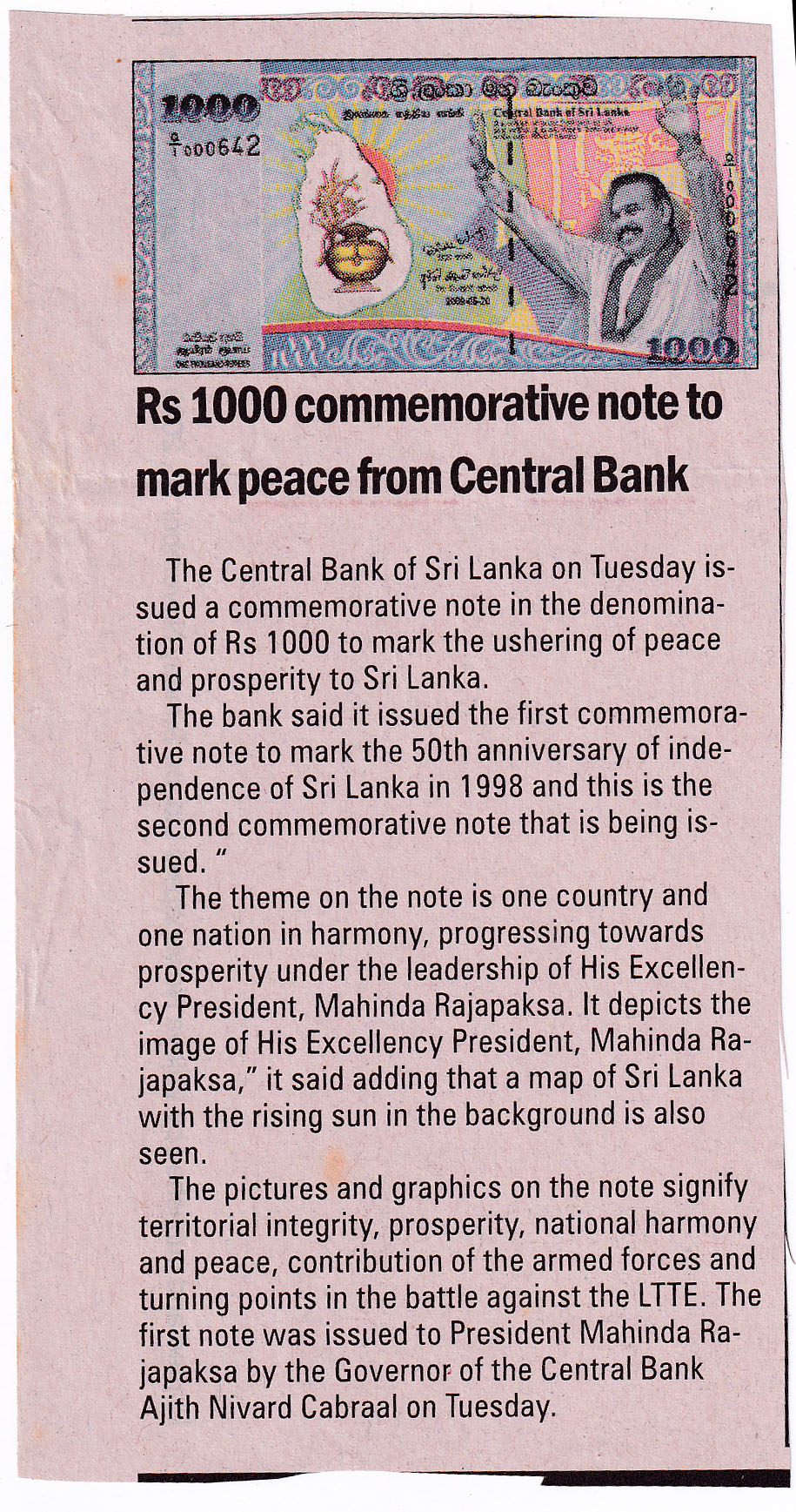
THIS COMMEMORATIVE NOTE IS ISSUED BY
THE CENTRAL BANK OF SRI LANKA
TO MARK THE USHERING OF PEACE AND PROSPERITY
TO SRI LANKA

THIS COMMEMORATIVE NOTE IS ISSUED BY
THE CENTRAL BANK OF SRI LANKA
TO MARK THE USHERING OF PEACE AND PROSPERITY
TO SRI LANKA
Front: Landscape
The replacement note has a X/1 prefix.
It is the first time since 1954, that an image of a living person has been
used on Lankan currency notes. Previously only portraits of British King
George VI (1941-1951) and Queen Elizabeth II (1952-1954). Late Prime Minister
S. W. R. D. Bandaranaike appeared on some currency issues from 1961 to 1975.
The new currency note resembles the 1970 issue in which a portrait of the
Late S. W. R. D. Bandaranaike with his hand raised was issued. That issue was
withdrawn from circulation when it was deemed inappropriate by authorities to
have a symbol "the hand" of the ruling SLFP political party prominently on
currency issue.
The back of the new note has a montage of images from Mavil Aru
annicut to Thoppigala rock which were important land marks in Eeelam
War IV.
Except for the 1998 commemorative, Polymer Note which was printed at
Note Printing, Australia, all Lankan Currency Notes since 1991 have
been printed by Thomas De La Rue and Company Limited, who have a press
in Biyagama, Lanka. On very reliable source, 25 Million of new notes
were also printed by DE LA RUE.
They did not use some regular security features such as raised
Intaglio printing, wide security strip, but charged more because of
the Rush Order. It is one of very few Lankan currency notes to not have the Printers Name on it. I suspect
they were too embarrassed to state their name on this low quality
Currency Note. The 1979 Bird series, the 1981 High values, and the
1998 polymer note also omitted printers name. I am told it is not a
legal requirement.
By late 2009 December, I got a Q/10 note from circulation indicating
that more than half the printed notes have been released to
circulation. A bank told me that CBSL only issuing these Rs1000/- notes.
The Rs1000 note was first issued in 1981 in Green, the color of the
UNP which was ruling at the time. The image was changed to the Late
Maligawa Tusker Raja in 1991 when the UNP which uses symbol of an
Elephant was still ruling. It has now been changed to Blue, which is
the color of the ruling SLFP. This is not however the first time color
was changed by Politics. According to Mr T. M. U. Sallay, back in
1964 June the Blue Rs50/- note was printed in Red (color of LSSP) on
the request of the then Finance Minister N. M. Perera. However because
of the change in government in 1965 March, these currency notes were
never issued and were subsequently destroyed after the demonetizing
exercise of 1970.
Currency issued in Lanka since 1977 avoided using Portraits of personalities
and the issues contained images of Flora, Fauna, Historical, Archaeological
Development and Heritage of Lanka. It is my understanding that the original
design for this new commemorative note also adopted this policy. The design
appears to have been modified in the new political
climate.
A limited number of notes (10,000) with the first serial numbers are being
issued in an attractive folder printed in only in English, at a price of
Rs. 1,500 (US$13) each. The rest have been issued into circulation at
face value and available from CBSL or any Bank.
This is the second occasion when a commemorative currency note has
been issued. The first was for the 50th Anniversary of independence in
1998, when a blue Rs200 polymer
note was issued.
The Polymer note was not accepted well by the public used to handling
paper currency. The note although still legal tender is being removed
from circulation, and now rarely seen. Currently only about 3% of the
just over 20.5 million notes issued are in circulation or with collectors.
Initial acceptance of the new note by public is mixed. I was told that it was
refused when returned to a customer as change in a store. He had said he did
not want a political note, probably thinking it was one of the many fantasy
notes
that have appeared in recent past. In a press release last month, CBSL has
advertised Monetary policy which included the statement that the
"Reproduction or imitation of any currency note using a photograph of a
person, slogans designs or artwork for any propaganda purposes (eg.
political, marketing, commercial, social, economic etc), may also be considered an
offense." It appears that CBSL does not follow spirit of their own policy.
In violation of this law, I have heard that the opposition is writing
their own slogans on this note, before spending it. Keep a look out
for one when they pass through your hands. I have a used 1982 Rs10
note with Sinhala slogan Uthura Amirta, Dakuna Reaganta, Apita Kanththa.
The Rivira (Sinhala weekend Newspaper) of 2010 January 3rd, has a
front page headline story and an extended half page
article
on the inside backpage about the manufacture of fake Rs 1000/- mahinda
notes. Almost a how to guide. Few young computer geeks have got
caught. Claim that they produced about 200 of these fake notes have
gone into circulation.
This note has also been subject to much parody.
A few days after it was issued on 2009 November 21st,
a LTTE Fantasy Padody Note was published online by
www.eelamhomeland.com. Original domain has now expired.
A few years later in 2012 February-March when the Sri Lankan Rupee devalued
by 15% in 6 weeks, Cartoonist Dharshana Karunathilake published this
Cartoon in the Sunday Lakbima.
When I first saw it in 2016 June, among a collection of his cartoons
I thought it reflected the dramatic defeat of Rajapaksa Presidecy
on 2015 January 8th, after calling elections 2 years early on the
advice of an Astrologer.
In 2015 March UK Tamil News posted another Mahinda
Parody
with "In China We Trust"
THEME: One country and one nation in harmony progressing towards
prosperity under the leadership of His Excellency the President,
Mahinda Rajapaksa.
DESIGN: Black & White Image of His Excellency the President, Mahinda
Rajapaksa with both hands raised to the right, with National lion Flag
in background. A map of Sri Lanka with the rising Sun in the background
and a "Punkalasa" with ears of paddy at centre left depicts territorial
integrity and prosperity respectively, that are result of national harmony and peace.
ශ්රී ලංකා මහ බැංකුව in Sinhala at Top center, and
இலங்கை
மத்திய வங்கி in Thamil
and CENTRAL BANK OF SRI LANKA in English on next line in smaller text.
Legality Legend in tiny Sinhala text 3 lines below the English Text
ශ්රී ලංකාණ්ඩුව වෙනුවෙන් නිකුත් කරන ලද මේ
මුදල් නෝට්ටුව ශ්රී ලංකාව ඇතුළත ඕනෑම මුදල් ගණනක්
ගෙවිම සඳහා නිතියෙන් වලංගුය
Numeric 1000 at upper left and lower right.
At bottom left in 3 lines the value
රුපියල් දාහයි in Sinhala,
ஆயிரம் ரூபாய் in Thamil,
and ONE THOUSAND RUPEES in English.
In lower center Facsimile signatures above මුදල් ඈමති (Finance Minister) Mahinda Rajapaksa, and
the මහ බැංකුවේ අධිපති (Central Bank Governor) Ajith Nivard Cabraal, with date 2009-05-20 below.
Size of numbers in serial number increase in size.
Horizontal Black Serial number on upper left and vertical Black Serial number on right.
Security Thread:Starchrome with 2.5 mm width, which changes colour from red to green with the letters CBSL RS1000.
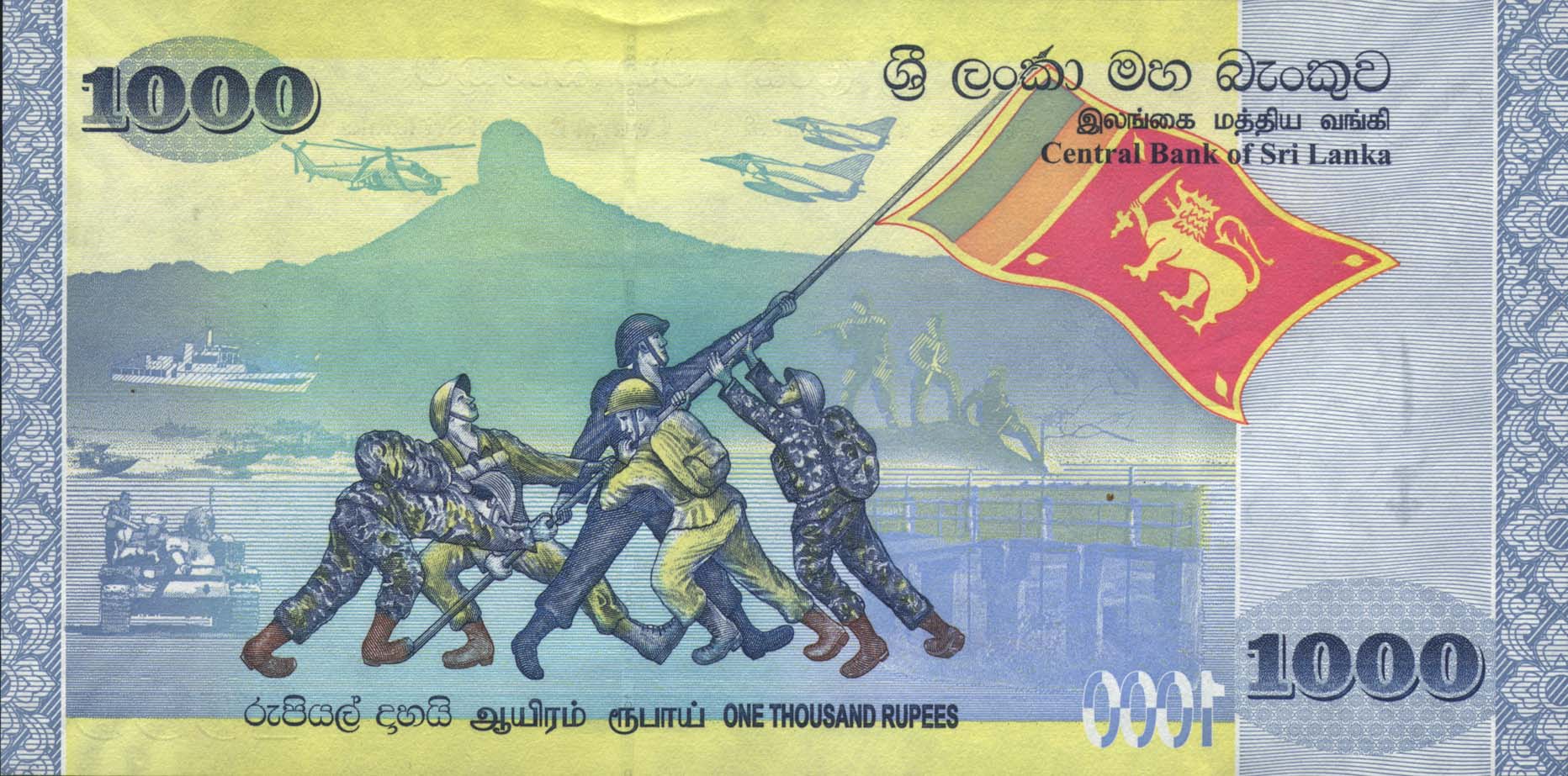
THEME: The valiant contribution made by the nation's victorious sons
and daughters of the security forces and the police.
DESIGN: Hoisting of the national flag by members of the security
forces appears in the centre. Images of the Mavil Aru annicut and
Thoppigala rock (Baron's Cap) which were turning points in the battle
against terrorism and operations of the security forces appear in the
background.
 Numeric 1000 at upper left and lower right.
ශ්රී ලංකා මහ බැංකුව
in Sinhala,
இலங்கை மத்திய வங்கி in Thamil
and CENTRAL BANK OF SRI LANKA in English, in 3 lines in upper left.
රුපියල් දාහයි in Sinhala,
ஆயிரம் ரூபாய் in Thamil, and English ONE THOUSAND RUPEES in one line lower left of center.
Numeric 1000 at upper left and lower right.
ශ්රී ලංකා මහ බැංකුව
in Sinhala,
இலங்கை மத்திய வங்கி in Thamil
and CENTRAL BANK OF SRI LANKA in English, in 3 lines in upper left.
රුපියල් දාහයි in Sinhala,
ஆயிரம் ரூபாய் in Thamil, and English ONE THOUSAND RUPEES in one line lower left of center.
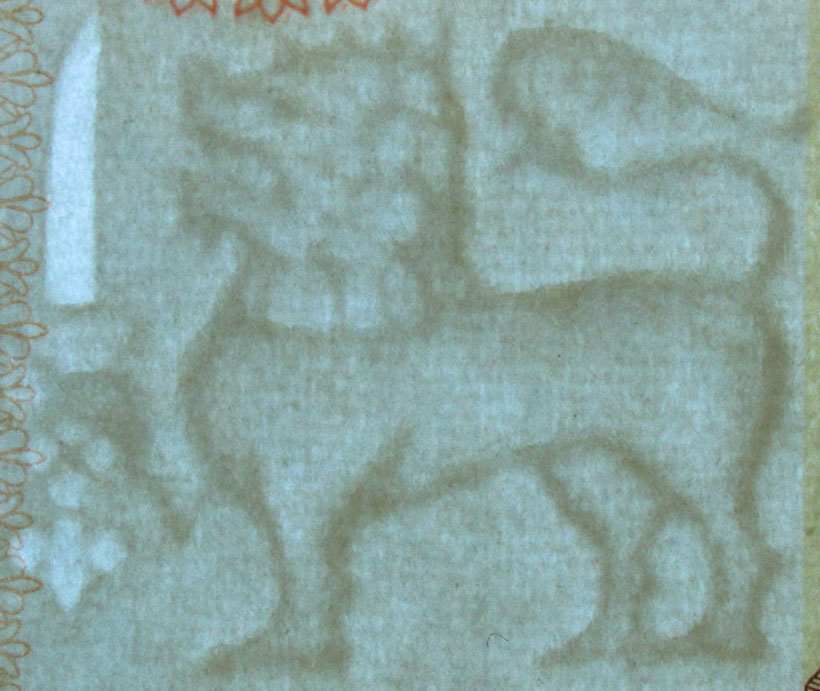
Watermark:On lower left darker than background, from National
Flag, Standing Lion facing left, front right raised with vertical sword
lighter than background.
UV Printing:
Front: Minimal.
Highlighted Green square with numeric 1000 in large Font,
upper left of center on top of Jaffna on outline of Sri Lanka Map.
Back: None.
Click image to see Note Security under UltraViolet illumination
Latent image: None
Predominant Color : Blue |
Size : 157 x 78.5 mm
Serial Prefix : Q |
Replacement Prefix : X/1
Florescent Fiber : None |
Braille : None
Mintage : 25,000,000 |
Folders : 10,000
Range of Serial # : Q/1 000001 - Q/25 1000000
Printer : Thomas De la Rue, Sri Lanka
Folder:
Cardboard commemorative folder 197x108mm in dimensions has 4 folds
with the currency note (157x78.5mm) encased within a 158x78mm
transparent Mylar window which has been the cut out of middle folds.
The text only in English is printed in white on a black background.
Center of back cover of folder has text in five lines
Central Bank of Sri Lanka, No 20, Janadhipathi Mawatha, Colombo 1 Sri Lanka
www.cbsl.gov.lk.
Small Logo of PrintCare
appears on the lower-right.
The low serial number uncirculated note was obtained with folder from
the Central Bank of Sri Lanka on 18th November the first day they were sold.
Point of View
Politics Again in Lankan Currency
 The front of the new currency note has a Black&White picture of the victorious
president, His excellency Mahinda Rajapaksa with both his hands raised.
This new issue even includes the signature UPFA
red curve
(wave) getting thicker towards the left on blue at bottom of the front
of note, as well as the front and back of the special folder.
The front of the new currency note has a Black&White picture of the victorious
president, His excellency Mahinda Rajapaksa with both his hands raised.
This new issue even includes the signature UPFA
red curve
(wave) getting thicker towards the left on blue at bottom of the front
of note, as well as the front and back of the special folder.
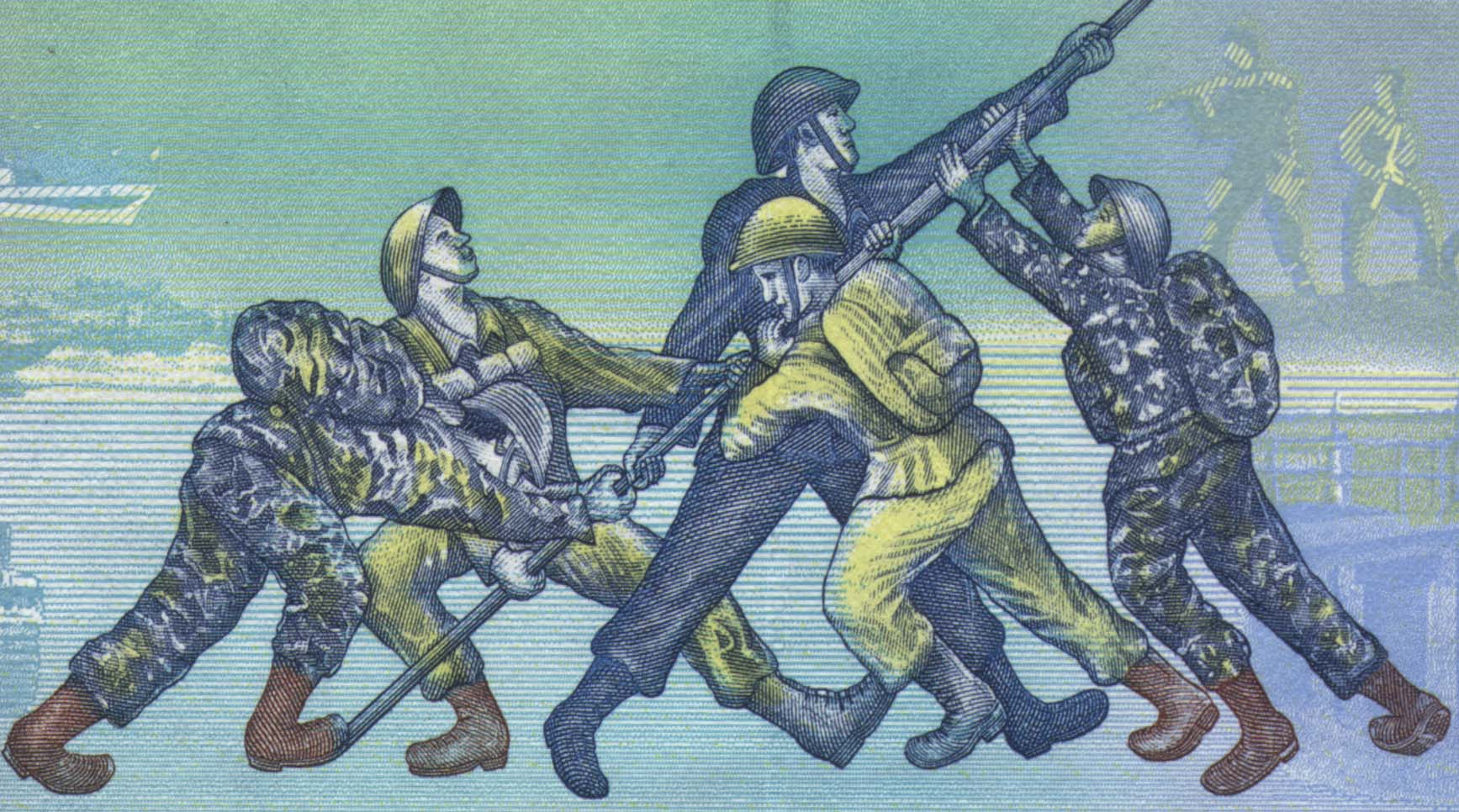
The center piece is an images of five soldiers raising the national
flag. The pose has clearly been plagiarized from the iconic World War II
picture
of five American Marines raising the flag on Iwo Jima in 1945. The
faces are not south-asian (they don't have slant eyes for example),
and the helmets, dress and boots unlike those currently used by SLA.
In any case it must be just a drawing since the basic perspective is
also wrong, such as the legs in front are significantly smaller
than the legs behind. The CBSL Press release nor the folder stated
the name of the designer, as is customary. I am unofficially told it
was Central Bank artist Mr Kelum Gunasekera.
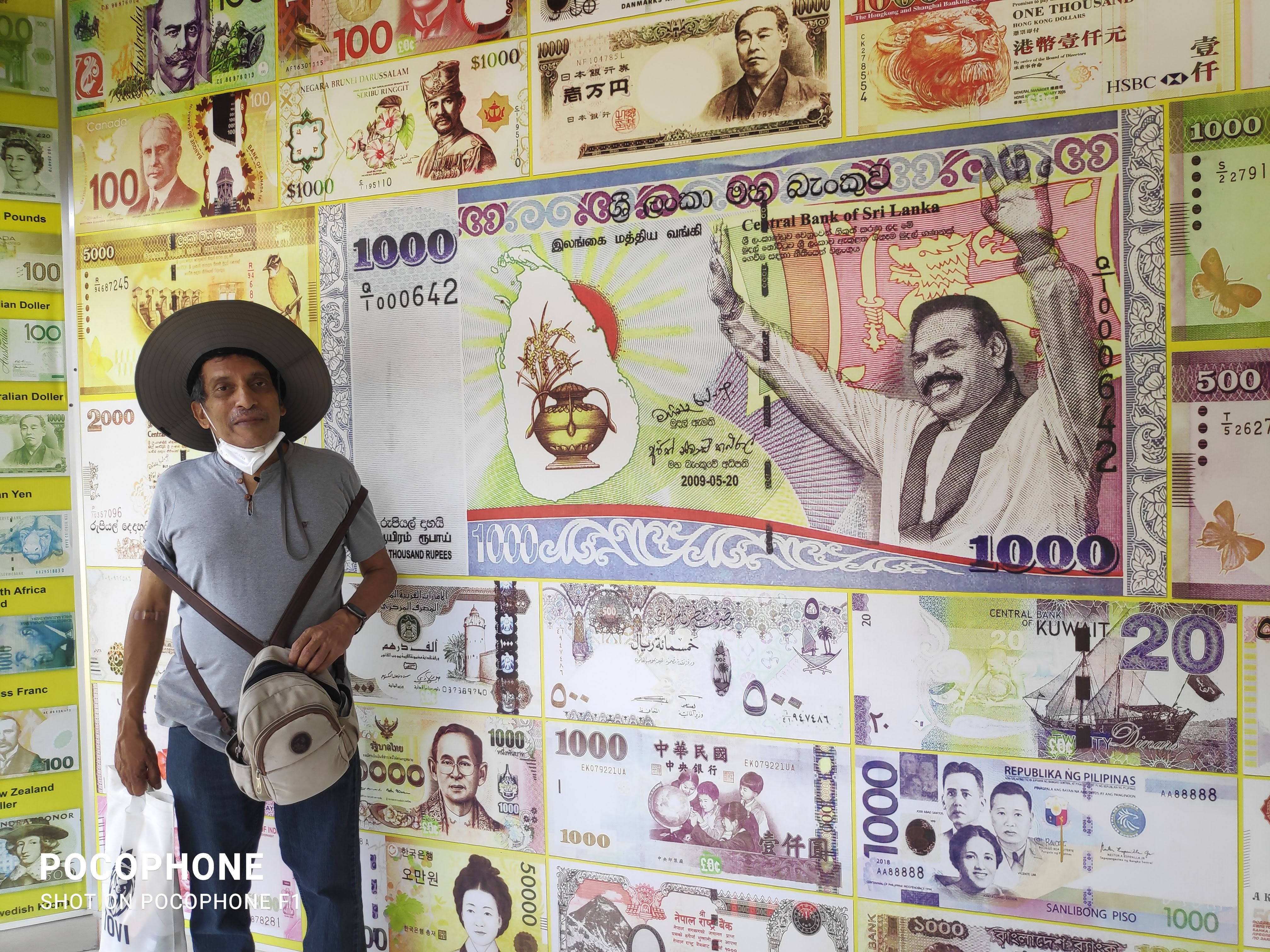 I had seen image of my note with serial Q/1 000642 printed as
docoration outside the temporary Foreign Exchange booth in Crescat
Shopping Center many years ago. More recently I had seen same image
printed poster size to decorate the walls of many Money Exchange shops
along Bristol Street in Colombo Fort.
I had seen image of my note with serial Q/1 000642 printed as
docoration outside the temporary Foreign Exchange booth in Crescat
Shopping Center many years ago. More recently I had seen same image
printed poster size to decorate the walls of many Money Exchange shops
along Bristol Street in Colombo Fort.
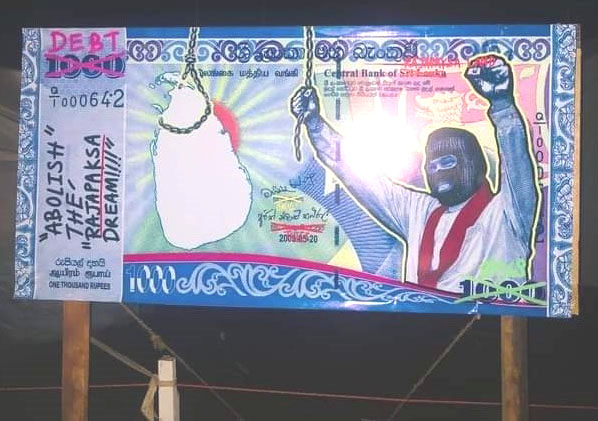 During the 2022 Protest Aragalaya against the jaRapassa,
I received shared on WhatsApp. the photograph of this Large Banner on right
Location unknown. I did not see it at the Aragalaya site in Galle Face Green.
During the 2022 Protest Aragalaya against the jaRapassa,
I received shared on WhatsApp. the photograph of this Large Banner on right
Location unknown. I did not see it at the Aragalaya site in Galle Face Green.
 See also
For collected details of the images on this Banknote see
NotesCollector.